Thankful Archivist

My Thanksgiving usually is comprised of gorging myself on deviled eggs, watching football, and taking crap from the Buckeye wing of the family, again… *sadness filled pause*

Anyway, besides the usual thankfulness of health, happiness, a wonderful family, and a spouse who likes college hockey, this year I will be adding things that have either helped in my budding career, or that helps our profession. Here are some highlights:

Open Source Software and Freeware OK, I know this is an geeky way to begin my list, but it is true. The computer on which I am currently typing also has local installations of Archivist’s Toolkit, Drupal, WordPress, and Apache. I know that open source is not necessarily free because of the learning curve involved, and sometimes it can be kind of frustrating being on your own. However, I love the fact that I can download these tools and play with them. Imagine if we had to go to Microsoft or some other vendor for all of this stuff. I am hoping soon to make the switch to Open Office, and maybe even a Linux based system as well (perhaps it will run on a solar powered machine made of granola and hemp).

The National Treasure Franchise Yes, the Nicolas Cage character is not an archivist and there are several things in that movie that made us all cringe, but let me tell you a story. The first movie was released to video at about the same time I did a short internship at NARA. I watched the video with my then 6 and 10 year old nephews and offhandedly mentioned that I was just at the National Archives. The six year old asked me if my job was like what Nicolas Cage’s character does in the movie. As I pondered my answer, I first looked at the TV, on which Nicolas Cage was rolling the Declaration up like a Bon Jovi poster and partaking in some witty banter with the beautiful conservator. I then looked at my nephew, who was waiting for my answer, his trusting eyes looking at me with anticipation. I said: “Yes, yes it is.” I will continue this lie until he is old enough to understand that the truth of what Uncle Lance does is actually as cool as the lie. So, despite the bad preservation practice and historical inaccuracies, anything that makes me look cool and puts butts in the seats at the National Archives is alright by me. Besides, if you are going to misrepresent what an archivist does, it could be worse (before I get sucked into the debate on the preceding clip, I refer you to Derangement and Description, whose take on this matter is spot on).

Grad School Cohort/Twitter Before I went to grad school, a friend of mine, whose wife earned a MBA a couple of years earlier, told me that my grad school cohort will become quite important to me. Well, Chris from New Jersey was right. Even though I am older than most of my former classmates (that is why this blog is called NewArchivist, not YoungArchivist), they have proved to be an invaluable help to me by providing a place to ask “dumb” questions and vent about the common frustrations of a new professional. I see the group of archivists on Twitter as a similar type of resource. While Twitter interaction obviously lacks the face to face element (and you run the chance of broadcasting your ignorance to the world), where else do you have an opportunity to communicate with archivists from all different locations, expertise, and experiences (without having to risk getting mired in #thatdarnlistserv)? I do not get a chance to contribute as much as I would like on Twitter, but I hope to increase my participation in the future and help add my small part to that discussion.

Well, there is a sampling. Please feel free to add some of your thankfulness to the comment section, and happy Thanksgiving from all of us at NewArchivist!

Deviled Eggs are Freakin' Awesome

Deviled Eggs are Freakin' Awesome

Egg image courtesy of Flickr member crowdive / CC-BY-NC-SA

Comments Off on Thankful Archivist

Filed under By-Lance

The Problem with Pioneering

When you’ve just graduated and are still looking for a job, it’s easy to feel like getting that first job will solve all your problems.  Then you get the job offer and it comes with a whole new set of adventures to tackle.  If you’re like me, you plan and implement your move half way across the country in the span of three weeks.  If you’re really adventurous, desperate, or the job is just awesome, you might find yourself moving to a place where you don’t know anyone.

During and for the first month after my move, I enjoyed the challenges that were coming my way.  The people in my office are simply amazing.  They’re really good at answering my questions about things like where I should look for curtains and how cold I can expect it to get in Boston this winter.  I actually found my apartment because my boss has a friend who is a realtor.  You have to love the boss who meets you when you get off the bus from the airport and presents you with a city map.  (I have to say this is probably one of my favorite gifts ever because it is useful and expresses confidence in my abilities, sort of like when Dad gave me a car jack the Valentine’s Day after I turned 16).  During this time, I had fun pretending that I was a pioneer, striking out on my own to make my way in the world.  As Dad pointed out before I left, it’s not like things were two hundred years ago when people left home and never came back, when it could take weeks or months to get a letter half way across the country.  For a while, it was fun to wander around and buy new things, building my professional wardrobe and decorating my new apartment.

Then the adrenaline rush wore off.  It hit home that there wasn’t anyone in this city that I’d known longer than six weeks.  I felt (and often still feel) lonely and isolated.  There are many days when I wake up and just want to see the familiar face of someone, anyone that I have history with.  (Even if it was someone I hadn’t talked to often or maybe even actually liked when I knew them previously, I would love them just for being in this city at this time.)

I know that feeling at-home in Boston is largely dependent on me.  I won’t feel completely comfortable here until I have commitments (outside of getting up and going to work every day) and friends that I can call at the last minute when I suddenly decide that I absolutely must go out for pizza or who will help me sneak snacks into the movie theater and then make fun of me while I talk to the characters on screen.   This weekend I joined a brunch group that I found on meetup.com.  I figure that brunch is a nice, safe way to meet new people.  In the spring I’m planning to take some sort of lessons that involve boats; I’m not sure whether it will focus on rowing or sails, but regardless, it will not be an activity I could easily pursue in Missouri.  And until I have memories in Boston, I still have my phone and friends all over the country who are going through the same thing.

5 Comments

Filed under By-Katherine

Feeling Inadequate? You’re Not Alone!

We are excited to have Bria Parker as a guest contributor this week. Bria has a Master of Science in Information and works for a large academic library in the Midwest. She is also the first New Librarian to contribute to our site (we are so inclusive). I think this post is something that a lot of us new information professionals are grappling with and will spark some great comments, so please feel free to add yours. Thanks for the awesome post, Bria! ~ Ed.

DISCLAIMER: I have a great boss, and none of this is directed at him. ~ Bria

If you’re like me, you were required to take some sort of management course in Library School (Information School, Archives School, whatever). And if you’re like me, much of it seemed like a spectacular waste of time, because really, how many of us are managing a department or institution right out of grad school? Oh you are? How nice for you. You can stop reading now.

For the rest of us, management seems to be in the distant future. For now, we must content ourselves with being managed by others. Whether your an archivist, librarian, or like to live dangerously and walk a fine line between the two, being managed, being a cog in the wheel, is not something grad school really prepares us for. Sure, sure, we are prepared for working in groups and we all probably are adept at interpersonal relationships. But that is with our peers. So what can we do to prepare ourselves for developing effective relationships with our superiors

Sure, sure, we’ve all had jobs before now in which we were managed, but when it comes to the professional world of libraries and archives, how do us neophytes operate in the pre-existing hierarchy that is [insert institution here]. We are now professionals, too, so how do we assert our thoughts and ideas when we disagree? What happens when you disagree with how things are done? Or about the way things are about to be done? What happens when you disagree so strongly that maintaining the status quo compromises your belief in what’s right? What can you say? What is the appropriate action? How could anyone get so worked up about old stuff?

If you’re a New Archivist, it is likely that you are currently facing this dilemma, or will soon. How does a new archivist (or librarian) balance the feeling that you might know more about a particular aspect than your superior(s) (either the particular aspect in question is your specialty, or you’ve studied it more recently than others) with the feeling that perhaps you’re just too naive to really understand the bigger issue. I was recently faced with this exact issue, and it broke my confidence. For months others and I had planned and planned, and had developed reasonable specifications. I felt like the research I had done, and all of my previous study really prepared me, and that the right path was chosen for the project at hand. Then someone stuck a stick in our spokes. “No. We aren’t doing that.” Umm…what? Had I been completely wrong? Where was this coming from? Do others not trust me? Am I too stupid to see something?

Unfortunately, a management class and group projects with peers did nothing to prepare me for such a crisis of faith in myself, nearly buckling to the decrees of others whom I felt did not truly understand the issue (despite us having talked about it for months).

The situation that brought on this rant has been resolved (thankfully) in a manner that did not require me to give up much ground (the compromise was a true compromise, with both sides giving a little). My colleagues and I were able to successfully defend the decisions and choices that were being questioned by others. No feathers were ruffled and nothing was as confrontational as the email exchanges leading up the successful meeting had indicated. This is a good thing. Yet while I leave this situation feeling that yes, my knowledge and training did prove to be correct, I was not really able to address the feeling of naivete and inadequacy that plagued me during the two weeks this went on. I was never able to resolve to myself whether or not one of the issues was that I just didn’t get the big picture.

Ultimately, this has been a great learning process for me, and no class would have prepared me for this lesson. But I’d like to know some of your experiences and seek your wisdom. In the future, what should one do? How can one manage the dichotomy of knowledge versus naivete? What if this hadn’t come to a peaceful solution? Should I have stood my ground and possibly made a bad impression? Or should I have buckled to their collective will? Enlighten me, New Archivists!

8 Comments

Filed under By-Bria, By-Guest_Contributor

The Derangement and Description of a NewArchivist

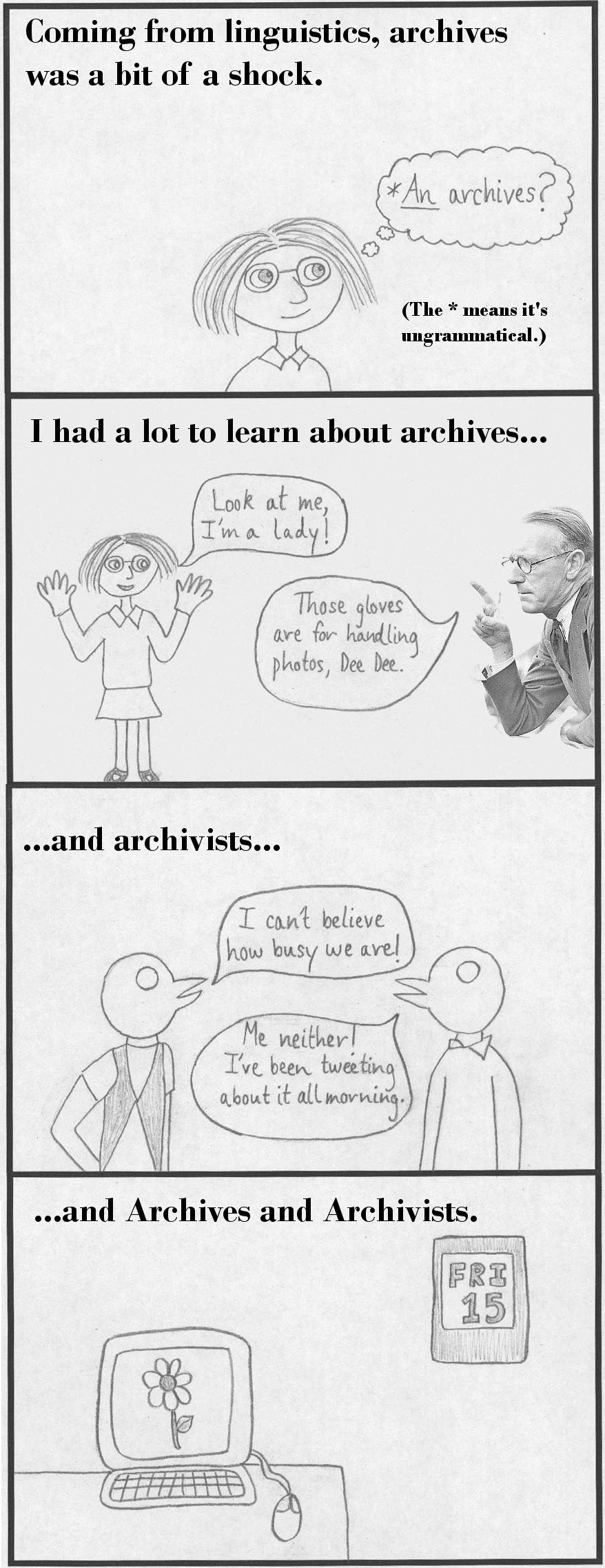
Our next guest contribution comes from no other than Rebecca Goldman of Derangement and Description. We are big fans of her work (not to mention Twitter buddies) and are thrilled she has contributed an original comic to the blog. Rebecca has, in her words, “NewArchivist cred” herself. She started her first archives job at the Drexel University Archives in August 2008. This comic is part one in a two part series, so keep you eyes peeled for the next installment. Thanks so much Rebecca!

nacomic_text

The photo in panel two comes courtesy of the State Library of New South Wales’ Flickr collection.

2 Comments

Filed under By-Guest_Contributor

Summer at the Library of Congress

We are pleased to welcome Heather Ball as our first Guest Contributor. She is a current student at the Graduate School of Library and Information Studies at Queens College in New York. We thank Heather for her contribution to NewArchivist!

Hello burgeoning archivists! I thought it might be interesting to share my experience from working at the Library of Congress this past summer. I was a Junior Fellow in the Manuscripts Preparation division, and my task was to fully process a roughly 45,000-itemed collection from accession to boxing and foldering. Though I didn’t quite complete the task in my three months there, I did accomplish and learn a heck of a lot. I also learned a lot about the Library itself, and about how collections are received and processed. One of the things that I found most interesting is that the Library is a lending library; anything that is on their shelves is open for user perusal—even the books from the Jefferson Library exhibit. Items out at our storage facilities in MD can even be retrieved and delivered to users in one day. Just imagine the enormity of the holdings, and the implications of this process- the Manuscripts Division alone has roughly 60 million items!

On my second day at the Library, my archivist came to me and another Fellow in the division and asked if we would give a presentation to tour groups from a local university the next morning at 9am. We eagerly agreed, so my archivist brought us into the bowels of the stacks to the “core” collection (approx. 100 of the library’s most popular items). These items are housed separate from their original collection so that tours or viewings can be put together quickly. She told us to pick eight items that best exemplify the library’s holdings, do some research, and write up a little bio of each piece. In two hours we picked our items, researched them, and prepared a presentation. The group was thrilled with our picks (which included a 15th cent. Icelandic MS; a bail petition from accused witches in 1692; a letter between Thomas Jefferson and John Adams talking about the tenuous relationship with King George; a Shaker painting from 1853; a punch card, plate and instructions from the first tabulating machine in 1895; the Woman’s Bible from 1898; a flag from the NAACP in the 1930s; and a telegram from 1941 announcing the Japanese attack on Pearl Harbor), which was a great feeling for a new professional.

Continue reading

Comments Off on Summer at the Library of Congress

Filed under By-Guest_Contributor

Three Things I Didn’t Learn in Archives School

First off, I am sorry for the delay in getting fresh material posted, we will be more regular in the future. Thanks to Angelique for reminding us that there are actually people reading this blog, who knew? ~ed.

I have been in my position now for almost nine months, part time from January to my graduation in May, and full time since then. Below I discuss the three biggest things I have learned on the job. Now, this post is not a complaint about my education, I think that these are inherently things that you learn on the job. There is also a distinct possibility that they actually did come up in school and I was not paying attention. On to the list:

3. Technology I think that most archives students in my program are pretty happy with the technological education that we received. I was not very fluent in technology and now I feel that I can converse freely in tech-talk. However, I also feel that perhaps I should have pushed myself harder in that area. Wouldn’t it be great if I had mad programming-skills? Let me answer that rhetorical question with a resounding yes. While I do not want to be a programmer or a IT person, I do think that a more solid base in the area would help me better understand what is required to implement things like digital repository software or other technological solutions. Even in a large organization like where I work, the more skills in this area would help me better communicate to the IT and programming people.

I will continue to work on these skills, both in the class room, on the job, and in everyday life (like, oh I don’t know, working to keep this blog going). The first few months of my employment have shown me that it is very important to keep up with these things. If nothing else, it will help me boost my nerd quotient.

2. Money This may be to be chalked up to complete and total naivety on my part, but I am really surprised how much the question of funding creeps into conversations, both at work and with fellow archivists. At school, we did not talk much about it, but I see that in the real world so much runs on costs and benefits. I think the question of money also goes beyond finding funding to sustain programs, staff, and projects. It seems that striking a balance between the public service orientation of most of our institutions and the real need to make business cases for the projects we undertake is an essential, and at the same time difficult, facet of our professional duties.

For example, I know that there is a frequently reoccurring discussion on the A&A listserv surrounding access. These discussions often outline the tension between access and the need to fund things like digitization efforts. I strongly agree with the assertion that archives have a responsibility to promote as much access as possible and should not exert additional controls, such as fees for high resolution images, on materials. However, I am also not as quick as some on the listserv to label archives that are charging fees as being in the wrong. These decisions must be difficult, and I am starting to realize that, no matter how much we archivist are not about the money, much of what we do requires it. Often that requires a compromise between the ideal and the possible. Note: I was going to make the last link go to that “show me the money” clip, but there is something unsettling about Tom Cruse yelling, unless it is in this.

1. The Management of People This is the big one for me and the thing that got me thinking about writing a post like this. I supervise student employees as part of my duties, as well as, obviously, work with a variety of people throughout my day. My dad, who was a human resources manager for a time, told me once that managing people was the most difficult thing he has ever done. Now, being a rebellious teenager at the time (well, as rebellious as a future archivist and lover of all things Star Wars can be), I thought to myself “How hard can it be?” The answer is: very. I think I am good at it, but it certainly takes much more of my day than I had expected. For me, the stress comes from the fact that I want to make sure that we produce top-quality deliverables and are rigorous in our research, without me coming off like:

Excellent

Excellent

The Simpsons 20th Century Fox Television

So, I have a strategy on how to make myself a better boss/employee/dude-that-people-work-with. I have taken a managers class offered through the university. This was very helpful, especially in the area of how to communicate better (and there was a lunch provided). I have also had several people recommend the book Crucial Confrontations, which has apparently spawned some workshops as well. While it does not really fall into the topics I usually read, I am willing to check it out. Mostly, I want to learn more from my mentors and, as I gain more experience, hopefully become a manager that can help successfully guide a team, without being the kind of boss that everyone (including me) hates.

8 Comments

Filed under By-Lance

My First SAA Conference: The Good, The Bad, and The Ugly

Since we were in hot and steamy Texas for the SAA conference, I thought I would have a Western theme to this post. Enjoy!

The Good: “Bringing it Together” Part of my excitement in attending the conference was to see if I could make connections from my time as a student to a professional. Some of the sessions did not disappoint. My favorite session, for this reason, was session 104 on archives and web 2.0 (see the SAA facebook page for videos of session 104 and more, nice job SAA!). Even though this really was not the most applicable session to my professional position, it was great in that it addressed how the profession can handle a topic that I was first introduced to in grad-school. Every professor I had, at one point or another, stated that archives had to do a better job being transparent. If I may go all postmodern on you for a second, transparency was identified as a way to address the notion that all human endeavor is biased in some way or another. If we cannot remove bias, we can at least be transparent in our decisions so future generations know where we were coming from. The first presenter in session 104, Angela McClendon Ossar, identified web 2.0 technology as a way to bring transparency to archival appraisal and processing. By blogging and tweeting, the archive can shed light on the black box. I thought this was a wonderful practical solution to a theoretical problem posed in the classroom. Awesome job!

There was also a surprising amount of good archive talk at the social activities I attended. While I guess it could be considered shoptalk, it was great to hear from working archivists. Whether it was a discussion of the meaning of records with some classmates fellow alums over $2 Lone Stars, or discussing how to appraise records based on documentation strategy over a sassy pinot grigio, I saw that every time a group of archivists gather it is another opportunity to learn something about the field. Note: all booze was consumed after the workday and not in excess, in case any people who could fire me, hire me, or are married to me, are reading this post.

Overall, I was very impressed how generous archivists are with their time and how willing they are to discuss things with someone new to the field. I am very excited to be in a profession where people are so clearly passionate about what they do and willing to lend a helping hand to others.

The Bad: “Why Are We Not Past This Yet?” While some of the sessions were great and really taught me a lot, some of them made me wonder why we were still talking about certain things as a profession. My example for this is session 501, whose official title was “More Product, Less Process Revisited: Choosing the Right Processing Strategy for Your Repository and Collections.” That sounds interesting, right? Well, in my opinion, the actual content of this session probably did little to help people choose a processing strategy, but rather “revisited” the type of debate that must have occurred when Greene and Meissner first published their article in 2005. Two members of the panel stated concerns regarding MPLP, including fears that widespread misuse of minimal processing will lead to the alienation our users, will make archivists irrelevant, and cause the McDonald’s-ization (yes, I just made up that word) of the profession. Update: OK, so apparently I did not make up McDonaldization. I guess I will have to Google words that I think I made up before I publicly claim that I made them up. HT to Angela McClendon Ossar.

You are not removing staples? Nooooooo!!!!

You are not removing staples? Nooooooooooo!!!!!!!

Image courtesy of Flickr member sparktography / CC-BY-NC

Now, this type of misuse of minimal process would be very disconcerting if it were not for the fact that, as far as I could tell, the evidence of misuse lies in anecdotal stories related during conferences and that SAA offers a workshop on MPLP. Um… really? It seems to me that we should have moved past a debate discussing the theoretical (and not to mention false) choice between “complete processing” and “minimal processing.” Is it not the reality that most archivists are adapting several different types of processing to accommodate the wide ranging and wonderful diversity among our archival institutions? I am not saying that there is not a place for a reasoned and rational debate on MPLP, or any archival issue for that matter. I am saying we should have that debate with facts in hand, and be a bit more aware of what is going on in the archival-streets (yes, I just made up that phrase).

In addition to MPLP, I feel there are other topics that we need to move beyond the acceptance phase. These topics range from user involvement, digital record management, and digital preservation. These are no longer new or radical concepts, and we should be talking about how to harness them, not engage in unhelpful hyperbolic claims that they are scary, unwanted, or cataclysmic to the profession.

Update: There seems to be a very interesting and relevant discussion brewing on the A&A, started by Kate Cruikshank of Indiana University, focusing on examples of how archivists are implementing minimal processing in their institutions, and a very informative post on ArchivesNext by Kate Theimer and Dan Santamaria. Nice work! There will also be a section dealing with MPLP in an upcoming issue of American Archivist, let’s hope this adds to the discussion.

The Ugly: “I am Freakin’ Tired” Archives is a second profession for me, my former profession being in the culinary field. I would come home from being in a kitchen all day bone-tired. While at the end of the day at SAA I did not smell of burnt grease, I was as tired as I was in any day in the kitchen. Not that I thought it would be all giggles and cupcakes (yep, made that one up too), but since I was out of my cubicle and pretty much on my own, I thought there would be a certain relaxation factor. Yeah, not so much. It is hard being “on” for that long of a time. I think my condition at the end of the week was similar to the condition of my name badge at the end of the week: worn out, misshapen, and mildly inappropriate…

Last longer... get it?

Last longer... get it?

Final Verdict: I will see you at SAA 2010, baby!!

4 Comments

Filed under By-Lance

Go Ask Alice.

(While a large portion of the archival population congregates at the SAA conference in Austin, I’ve been left to my own thoughts and copious 40th Anniversary Woodstock documentaries – both of which could lead to dangerous things…)

Lewis Carroll’s Alice in Wonderland features the iconic storyline of Alice’s meeting with a caterpillar while wandering through Wonderland. The Walt Disney Company adaptation of  Carroll’s stories into an animated film in 1951 gave the caterpillar a hookah-swirling, vowel-filled song. Voiced by Richard Haydn (oft remembered as ‘Uncle Max’ in The Sound of Music), the caterpillar repeatedly asks Alice about her identity, to which she can only splutter and cough under the pressure of his questioning and smog of his tobacco.

As archivists, we are often cornered and questioned on the specifics of our positions – likely in an audience that does not understand the answers we give. On the spot, we are required to create a working definition of “archivist” for those who are unexposed to the profession of appraising, preserving, and using unique records.

Do we attempt to educate our questioners on the specifics of the archival profession and functions, in the hopes that they will remember and perhaps pass the information along to others? Or, do we provide an easily-understood definition, so they can associate the profession with something comfortable and well-known? And, in constructing such definitions, how does it effect our view of ourselves?

As a (very) recent graduate, I am newly emerged from the theoretical educational realm, where situations become ideal and immune to the real-world effectors. There, we are surrounded by people of our own demographics – young, motivated, educated, enthusiastic, and, of course, hip. We come from mostly liberal arts universities, eager to break down doors, and “stick it to the man.” Like the caterpillar, we “cocoon” ourselves in this environment for two blissful years, only to emerge as fledglings with unsteady wings into a world with rules and restrictions.

After graduation, we find ourselves thrust into professional climates unlike where we’ve been. Archives found in government or corporate environments are filled with their own bureaucratic restrictions and likely limiting our initial grand intentions. Other archives are attached to non-profit organizations, limited by their financial constraints. This raises a whole new crop of questions: Do I follow the organizational culture and mold myself to the examples I see around me? Or, do I become the “ideal” hip archivist I want to be, asking questions and pushing boundaries? Do we risk alienating the established professional population, as Alice offends the caterpillar with her comment about being a “wretched” 3 inches tall? Which side of the mushroom do we choose?

Unlike us, Alice avoided the answering of her questions because “wonderland” turned out to be a dream, while we are forced to contemplate, if not confront, such questions head on. What my own answers will  be, I’m not sure, I just hope I don’t run into the Queen of Hearts while I’m trying to figure them out.

Comments Off on Go Ask Alice.

Filed under By-Jill

Postcard from Austin: Rainbows and Research

I will give a full recap of the conference when I return, but I wanted to give our loyal readers (yes, all three of you) some of my initial impressions.

I flew to Austin from Michigan on Sunday afternoon. I do not love flying, something about being packed in a metal tube with strangers thousands of feet in the air rubs me the wrong way. Added to that was the fact that is was like, 136 degrees in Austin. I was a touch grumpy upon arrival. But after I settled in, I saw this from my hotel window:

Rainbow Over Austin

Rainbow Over Austin

My grumpiness mellowed and my excitement returned as I hoped this was a portent to my week.

Research I have been pretty busy the first three days of the conference, sitting in on the Research Skills workshop on Monday and helping with logistics (which included frowning very hard at the hotel A-V dude) for the Research Forum on Tuesday. I liked the presentations from the Forum. It was a good mix of academic researchers and what I guess you would call “working practitioners.” I really like the attitude from some of the presenters that saw a problem, researched and developed a solution, all without the need for a grant or years of testing and development.

I also enjoyed meeting the people I had been communicating with via email over the past couple of months for the Forum. I was busy enough that I did not get to meet all of them, but I had some very good conversations nonetheless. It was great to meet people not from SI at Michigan (no offense, SI) that are working in different places and specializations. As I mentioned in an earlier post, I am not good at the networking thing and my previous correspondence with these folks gave me a great opportunity to approach and talk to them. Although I still have not collected any business cards…

Austin is Twitter-tastic I have been on Twitter for about five months now, and @TheNewArchivist has been on only a couple of weeks. I came to be a serious follower of people in the archives world during the last A&A listserv meltdown (if you don’t know what I am talking about, see the great post at Beaver Archivist). However, I did not realize that Twitter has such a robust archive community until this week. People have been great about helping others (like me who wondered where the Hell I was going to eat dinner) and give surprisingly rich details coming from the sessions and events I have not been able to attend. Not to mention, made us NewArchivists feel very welcome (a special shout out to @archivesnext for that).

Biggest Surprise So Far: I was so looking forward to the conference, that I was almost looking at it as a kind of getaway. Nope. All this fancy learnin’ is hard and I am beat at the end of the day.

More to come next week…

Comments Off on Postcard from Austin: Rainbows and Research

Filed under By-Lance

Austin, Here I Come

Next week will be my first SAA conference. Actually, it will be my first professional conference of any kind. I wish I could say something cool and cynical like “You know, I am just going for the beef brisket,” but I can’t. Truth is, I am really looking forward to it. In fact, on a scale of 1 to 10, my excitement level goes to 11.

Here are some reasons why:

1) Archivists, archivists, archivists I cannot wait to be immersed in a large group comprised almost solely of professional archivists and records managers. This is partly because I think it will give me a feeling of “I am now truly an archivist.” My wife put this into words the best when she said I am excited for the conference because I “will be around people who use the same terms and know the same acronyms, and will get your nerdy jokes.”

2) The continuing education of Lance I am looking forward to continuing my education outside of the formal school setting. My MSI program gave me some great tools, but I now want to see what professionals in the field have to say about the topics we learned in school. For me, digital preservation and web 2.0 technologies hold a special interest and I will be attending several sessions on those topics. Will they reinforce what I learned in school, or is the view different from the “trenches?”

3) Professional Engagement I will also be doing stuff at the conference that will provide me with several opportunities for shameless self-promotion to engage with other professionals. I have been providing some logistical support for the Research Forum, which will take place on Tuesday the 11th. This will feature posters and presentations highlighting research in the field. I have had a chance to see the proposals and the presentation look very interesting, I am sure I will get a lot out of it. Also, I will be presenting at the student poster sessions on a disaster planning internship I had last summer at ICPSR. I think these activities will help me meet more people, as I am absolutely terrible at networking. My awkward attempts at handing out my business cards are always good for a laugh or two.

Will not leave Texas without eating something resembling this!

Image courtesy of Flickr member athomson / CC-BY-SA

4) Austin I have only been to Texas once and it was a while ago with the family. I am really looking forward to exploring the city and seeing how Texas does a college town. I joked earlier about going just for the brisket, but I do plan on seeing what all the fuss is about, as well as checking out as much as I can of Austin (excepting the bats, not cool). The extras like going to a baseball game and attending the gathering for Michigan alumni will round out the social aspects of the trip [apparently there will be no Michigan reception, booooo ~ ed.]. By the way, for those also going to the conference, I have found the Austin Is for Archivists blog very helpful.

5) #saa09 I plan on going nuts with the web 2.0 at the conference. Hopefully, I will have time for some short posts here. I will definitely make time for numerous tweets from both my Twitter and TheNewArchivist Twitter as well.

There you have it. Like I said, I hope to add some more from the conference, but even if I don’t get a chance, I will write a post-conference-post and tell you if it lived up to my exciting expectations. Oh yeah, I will also give my review of Texas BBQed beef brisket.

6 Comments

Filed under By-Lance